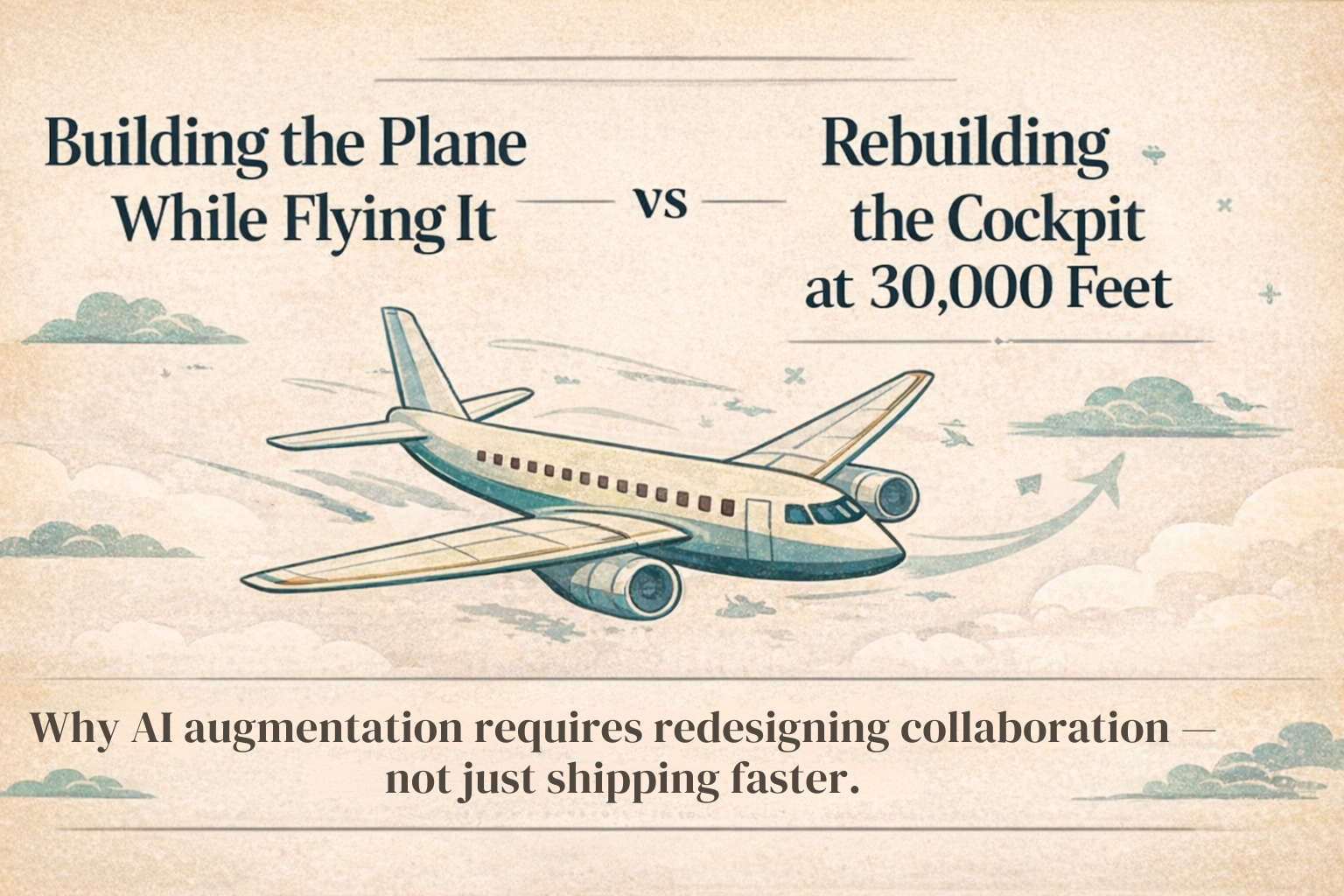
Augmenting teams with AI isn’t about rebuilding everything from scratch — it’s about redesigning how work happens while value is already being delivered.

Maura’s note
I’ve probably said “we’re building the plane while flying it” more times than I can count — in roadmap reviews, kickoff decks, exec readouts, customer calls, and those “wait, how do you all work?” moments with new teammates.
It’s a useful metaphor for Agile: move, learn, iterate. But while working hands-on with AI augmentation, I realized it doesn’t go far enough anymore.
AI doesn’t just change how fast we ship. It changes how decisions get made while we’re shipping — what gets trusted, what gets reviewed, what gets escalated, and who owns the outcome when AI is involved.
That’s where “rebuilding the cockpit at 30,000 feet” came from. It’s what it feels like when you’re redesigning collaboration while the team is still accountable for forward motion — and without outsourcing judgment.
Why this metaphor exists
“Building the plane while flying it” helped tech teams normalize iteration. AI introduces a new reality: we’re not just shipping improvements — we’re changing how decisions are made, reviewed, trusted, and owned.
“Build the Plane While Flying It”
A popular metaphor in Silicon Valley / Agile culture: ship, learn fast, iterate in production.
What it’s great at
- Faster time-to-market: learn in real conditions, not hypotheticals
- Customer feedback loops: iterate based on reality, not preference theater
- Risk reduction: smaller bets, earlier validation, fewer big-bang failures
- Team autonomy: continuous improvement becomes cultural muscle
Where it falls short for AI
- It assumes the “how” of work stays mostly the same
- It doesn’t fully address decision ownership under AI influence
- It underestimates trust boundaries, escalation paths, and durable context
Rebuilding the Cockpit (AI Edition)
Keep delivery moving — while redesigning the instruments, workflows, and collaboration patterns that keep the team safe and effective.
What it adds (without rejecting Agile)
- Clear accountability: the team owns outcomes (AI doesn’t “own” anything)
- Lower overhead: AI reduces coordination/synthesis load so humans focus on judgment
- Higher creativity: more options explored, more blind spots surfaced
- More reliable speed: faster without losing control
The core idea
AI changes the cockpit — not just the plane.
The teams that win redesign collaboration itself while delivery continues.
Redesign more than the tech
The “cockpit” is your collaboration system — how context moves, how decisions are made, and how quality stays reliable under pressure.
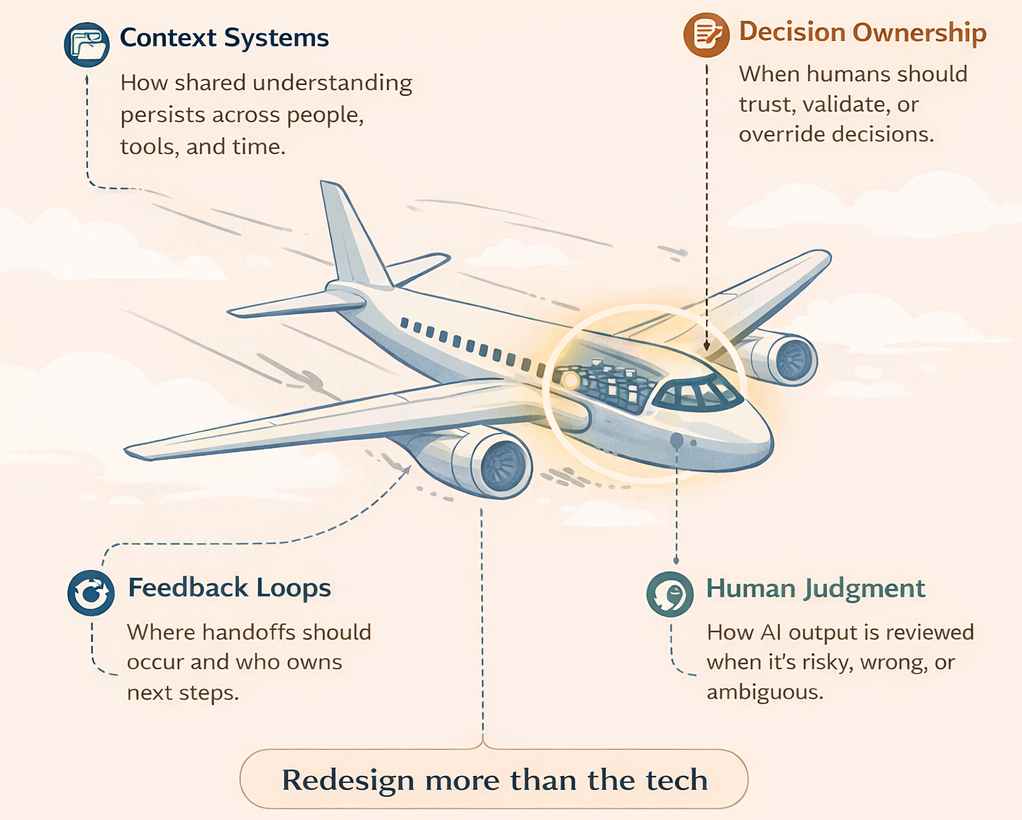
🧱 Context Systems
How shared understanding persists across people, tools, and time.
🧭 Decision Ownership
Who is accountable for AI-influenced outcomes? Answer: the team.
🔁 Feedback Loops
Where handoffs occur, how work is reviewed, and how learning compounds.
🧠 Human Judgment
How AI output is validated, overridden, escalated, and documented.
How to use this page (fast)
If you’re mid-flight right now, start here.
- Pick one workflow: choose a place AI is entering your team’s work this week.
- Answer the cockpit questions: context, roles, judgment, escalation — don’t leave them implicit.
- Add one ritual: Trust Check / Temp Check / AlignFirst to keep collaboration healthy.
- Document one decision: use Co-Sign to make ownership explicit and reusable.
The why: augmentation without overhead
This is the point of rebuilding the cockpit — not “AI everywhere,” but reliable impact.
AI augmentation isn’t about replacing human work or simply accelerating it. It’s about reducing unnecessary overhead — the coordination, recall, formatting, and synthesis work that quietly drains teams — so human energy can be spent where it matters most.
At the same time, AI introduces something teams rarely get at scale: an additional perspective that doesn’t fatigue, doesn’t self-censor, and isn’t constrained by meetings, politics, or time zones.
When designed well, AI expands a team’s thinking capacity — not just its output. It helps teams explore more options, surface blind spots, and make better decisions — without asking humans to work longer, harder, or faster.
That’s the promise of AI augmentation: more creativity, stronger judgment, and greater customer and business impact — not just more velocity.
Bottom line
The teams that win won’t be the ones with the “best prompts.”
They’ll be the ones who redesigned collaboration itself while the plane was still flying.
 aigal.io