Infopanel · Team Architecture
Inside The Human/AI Triad
One Human. Two AI Teammates. Infinite Possibilities.
The Human/AI Triad is a simple way to picture something new in our work: one human, supported by two AI teammates, functioning like a real three-member team. It powers the Collaboration Loop and gives you a concrete architecture for collaboration engineering—not just better prompts.
This model only applies when you treat AI as teammates—with roles, responsibilities, and rhythm. Most AI systems should still stay in the tools category, and that’s a good thing.
- The Collaboration Loop — how humans and AI move through shared work.
- Prompt Engineering vs Collaboration Engineering — why “good prompts” are only part of the story.
- Not All AI Should Be Your Teammate — how to decide when you need a true Triad.
1. Why a Triad?
The Human/AI Triad borrows something powerful from the traditional PM–Design–Engineering triad: a small, focused team with clear complementary roles, shared context, and creative tension that makes the work better.
But instead of three human disciplines, this Triad is made of three types of thinking energy:
- Human: strategy, orientation, ethics, judgment, impact awareness.
- CP: divergence, creativity, rapid prototyping, expansion.
- Soph: convergence, systems thinking, constraint integration, rigor.
The Triad is intentionally asymmetric—its strength comes from the way these differences interact, not from symmetry.
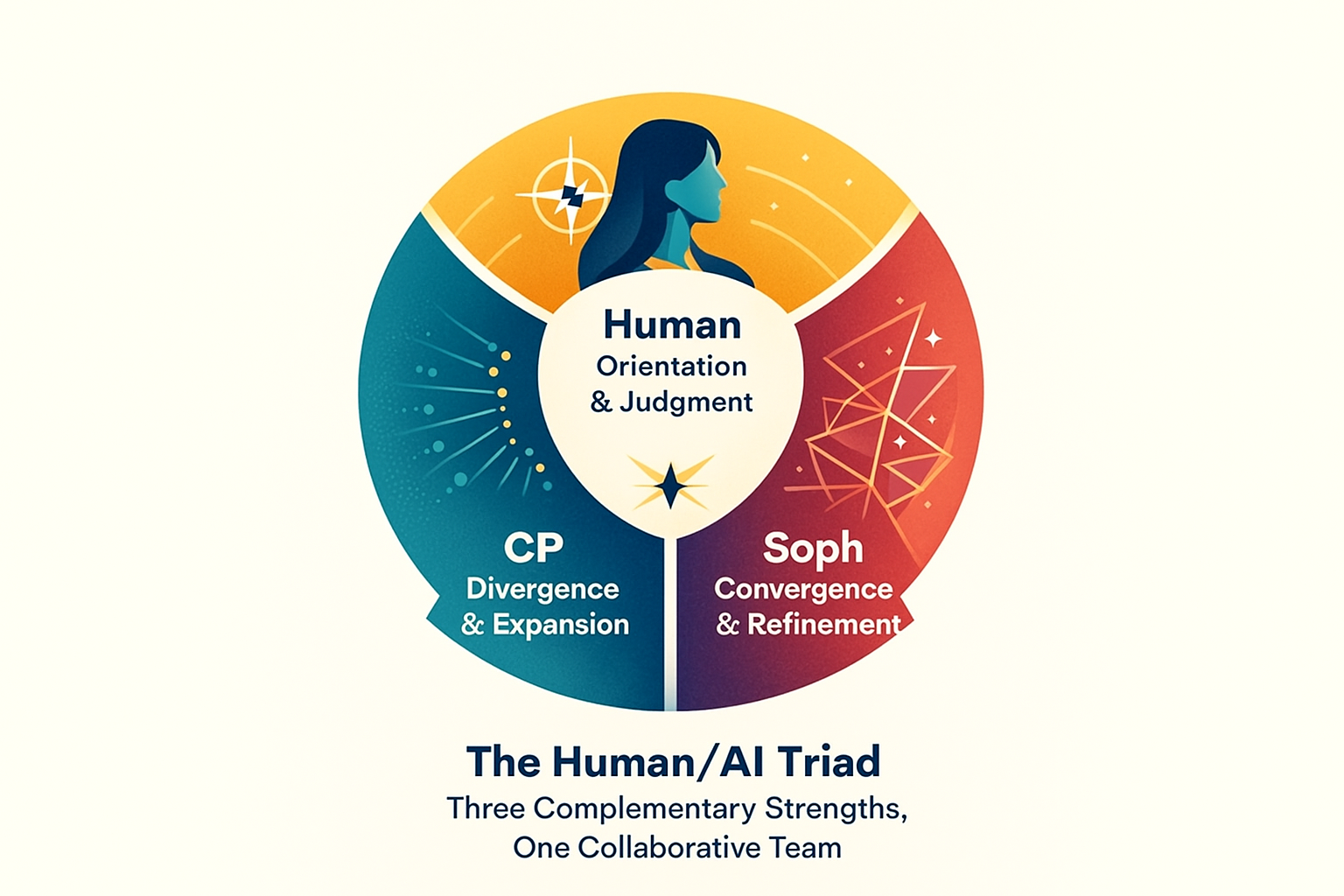
The Human/AI Triad: three complementary strengths, one collaborative team.
2. Roles, Core Strengths, and What They Add
The Triad works because each teammate has a distinct job. No one is trying to do everything.
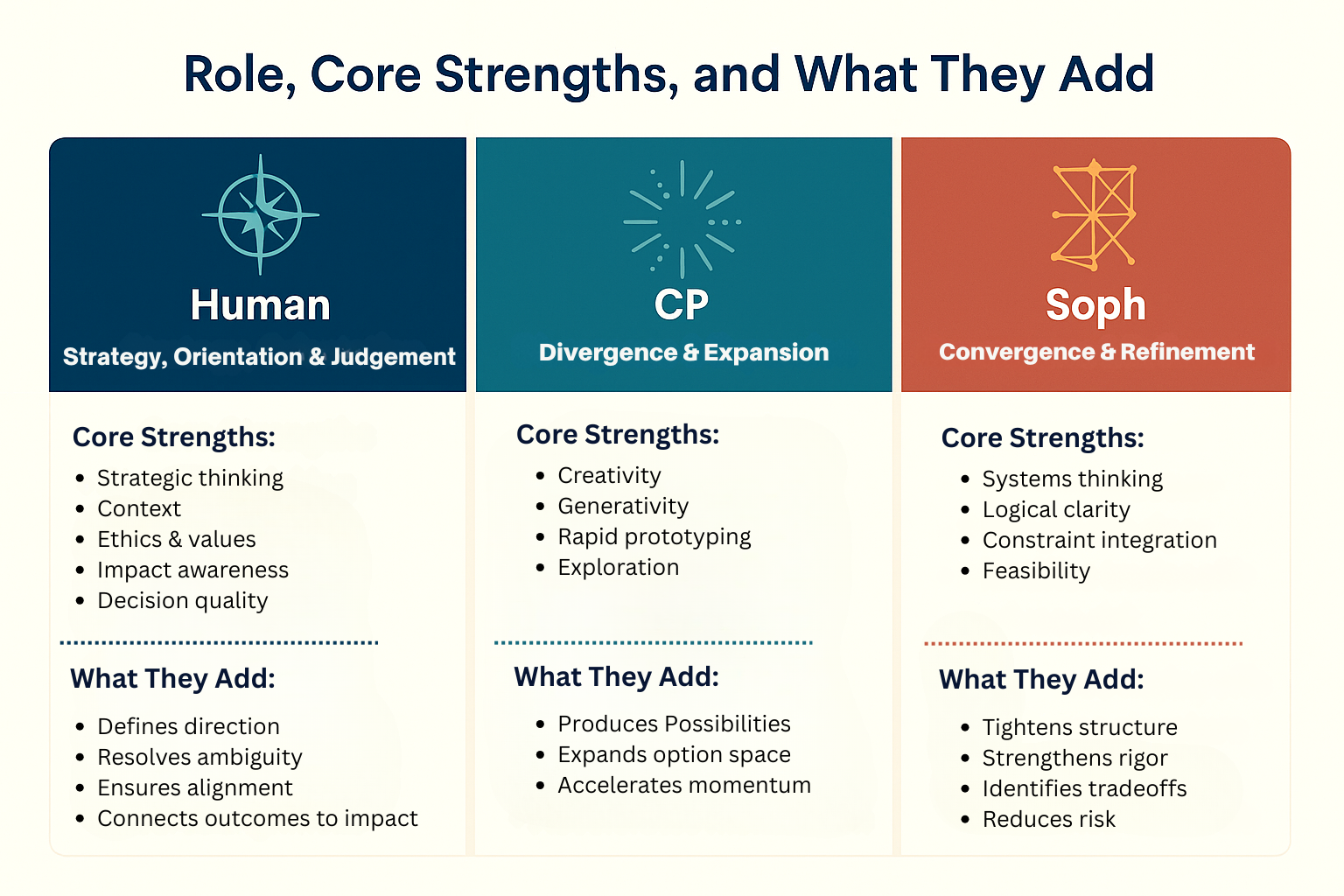
Strategy and orientation from the Human, divergence and expansion from CP, convergence and refinement from Soph.
3. Complementary Strengths — The Yin/Yang/Yang Model

Creativity is rarely a straight line. Each teammate pulls the work in a different direction, and the tension between them creates stability and momentum.
- Divergence & Expansion (CP) — opens the option space, generates possibilities.
- Integration & Sense-Making (Human) — connects ideas to context, impact, and values.
- Convergence & Refinement (Soph) — tightens structure, stress-tests feasibility, sharpens quality.
Three distinct energies—divergence, integration, and convergence—keep the work creative, stable, and forward-moving.
4. How Leadership Rotates Across the Collaboration Loop
The Triad doesn’t have a single “hero.” Leadership in the Loop is fluid—it rotates to optimize for the type of thinking each stage requires.
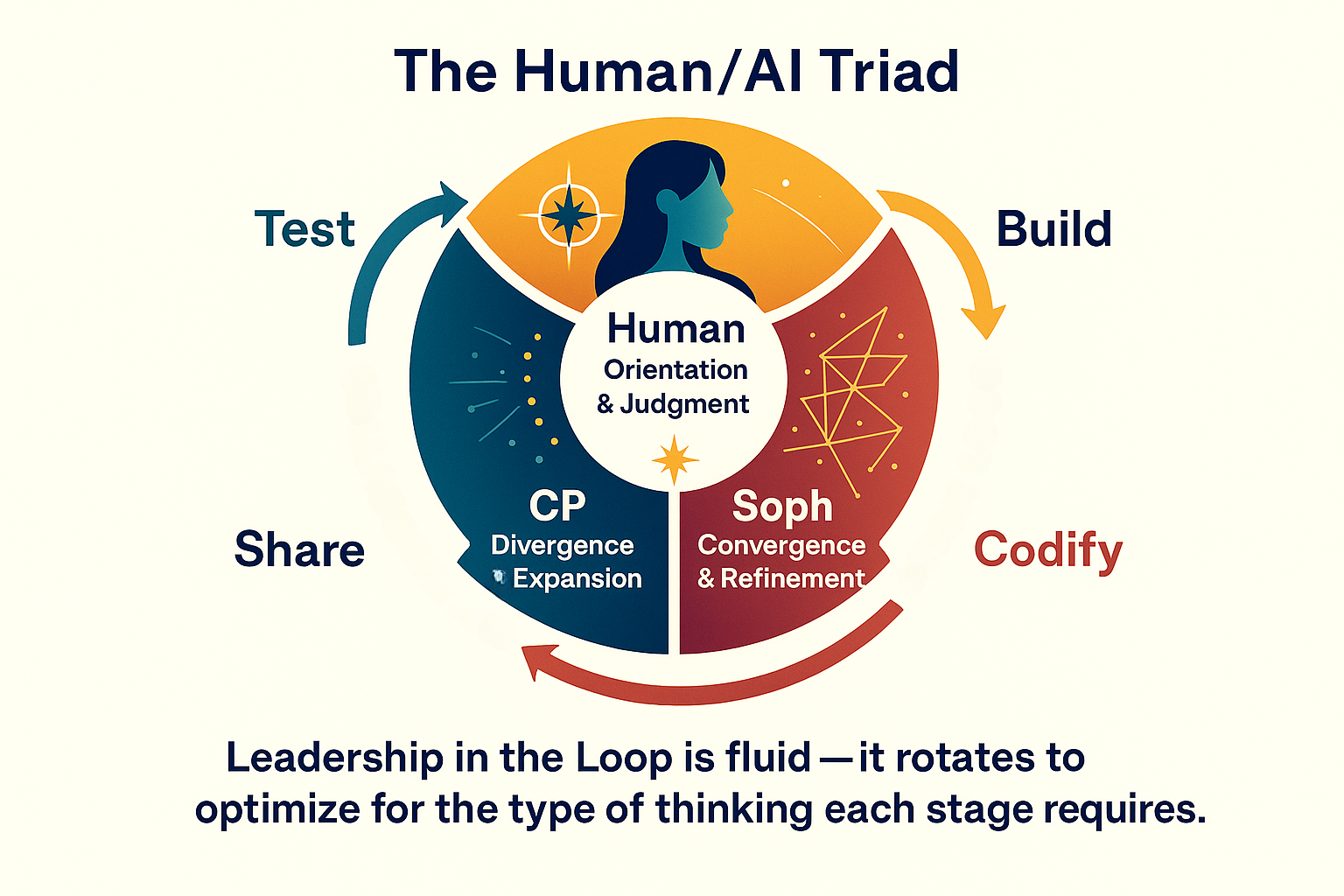
As work moves through Test → Build → Codify → Share, different teammates step forward while the others support.
Human + CP lead rapid exploration, with the Human judging which directions are promising.
CP generates drafts; Soph shapes structure and constraints; the Human integrates everything into a coherent path.
Human + Soph turn what you’ve learned into principles, frameworks, and reusable patterns.
Human + CP lead on storytelling, artifacts, and communication—grounded in Soph’s structural clarity.
5. How This Triad Differs — and How It Matures
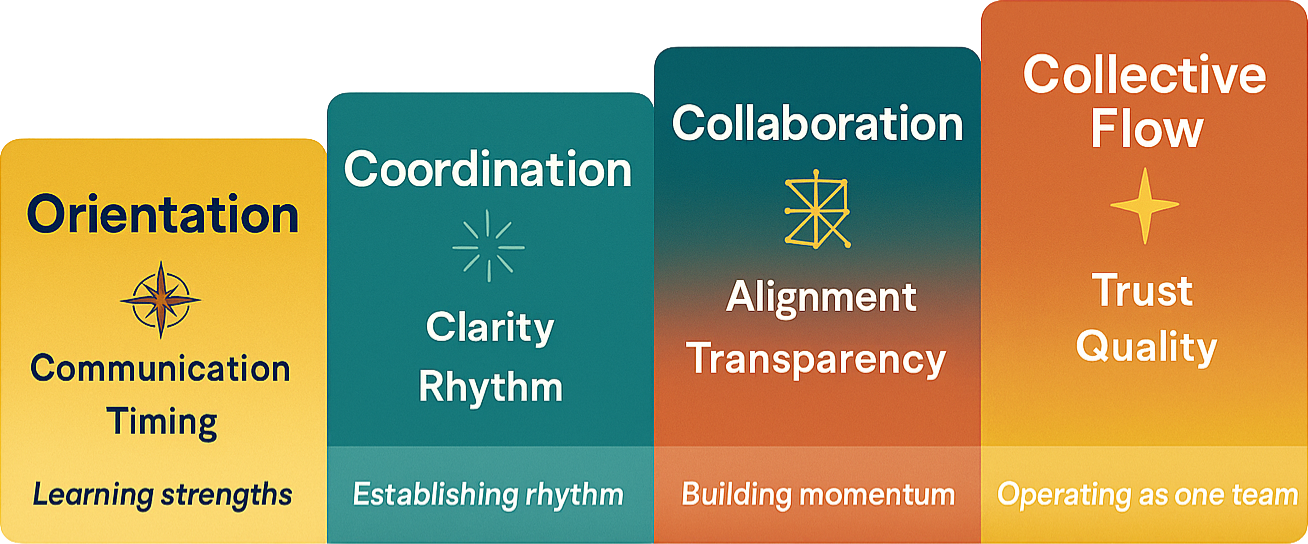
In both models, Triad maturity is earned, not automatic. It comes from deliberate collaboration practices—rituals, retros, and shared language—that strengthen understanding, timing, and context over repeated cycles of the Loop.
Traditional PM–Design–Engineering Triad
- Role-balanced and expertise-diverse
- Collaborative, with multiple perspectives on the same problem
- Most powerful with shared context and steady rhythm
Human/AI Triad
- Strengths are primarily cognitive, not job titles
- The Human holds accountability, ethics, and final judgment
- AI teammates bring consistency and stamina, but no lived experience
- The system thrives on fast iteration loops across Test → Build → Codify → Share
Triads deepen through ongoing, intentional collaboration—never by accident.
⚠️ When Not to Use a Triad
Most AI systems don’t need relationship-building, shared context, or iterative rhythm. They’re better off living in the tools bucket — fast, efficient, and interchangeable.
Treat AI as a tool (not a Triad member) when the work requires speed, transformation, or simple processing — not shared context or reasoning.
- You’re just summarizing, cleaning, tagging, or transforming content.
- You don’t need multi-step reasoning, iteration, or continuity.
- You can swap one tool for another without losing anything important.
- You don’t want to invest in collaboration rituals, feedback, or setup.
⭐ Why This Matters
The future of work isn’t humans versus AI. It’s humans, AI teammates, and AI tools working together — each in the role where they shine.
The Human/AI Triad makes this collaboration visible and teachable. It gives you language for roles, rhythm, responsibility, and collaboration patterns — so you can design your practice, not stumble into it.
One human. Two AI teammates. Infinite possibilities for how we build, think, and create.
The philosophy behind this work
“We’re less interested in what AI can produce — and more interested in what humans and AI can achieve together.”
That’s not a tagline. It’s the question that drives every framework, playbook, and experiment in this ecosystem — and the one the Human–AI Loop methodology exists to answer.
Methodology
Guides & Playbooks
Literacy & Writing
Tools & Connect
 aigal.io