
Human–AI Literacy Library · Episode 3
AI Doesn’t Forget
Like Humans Do.
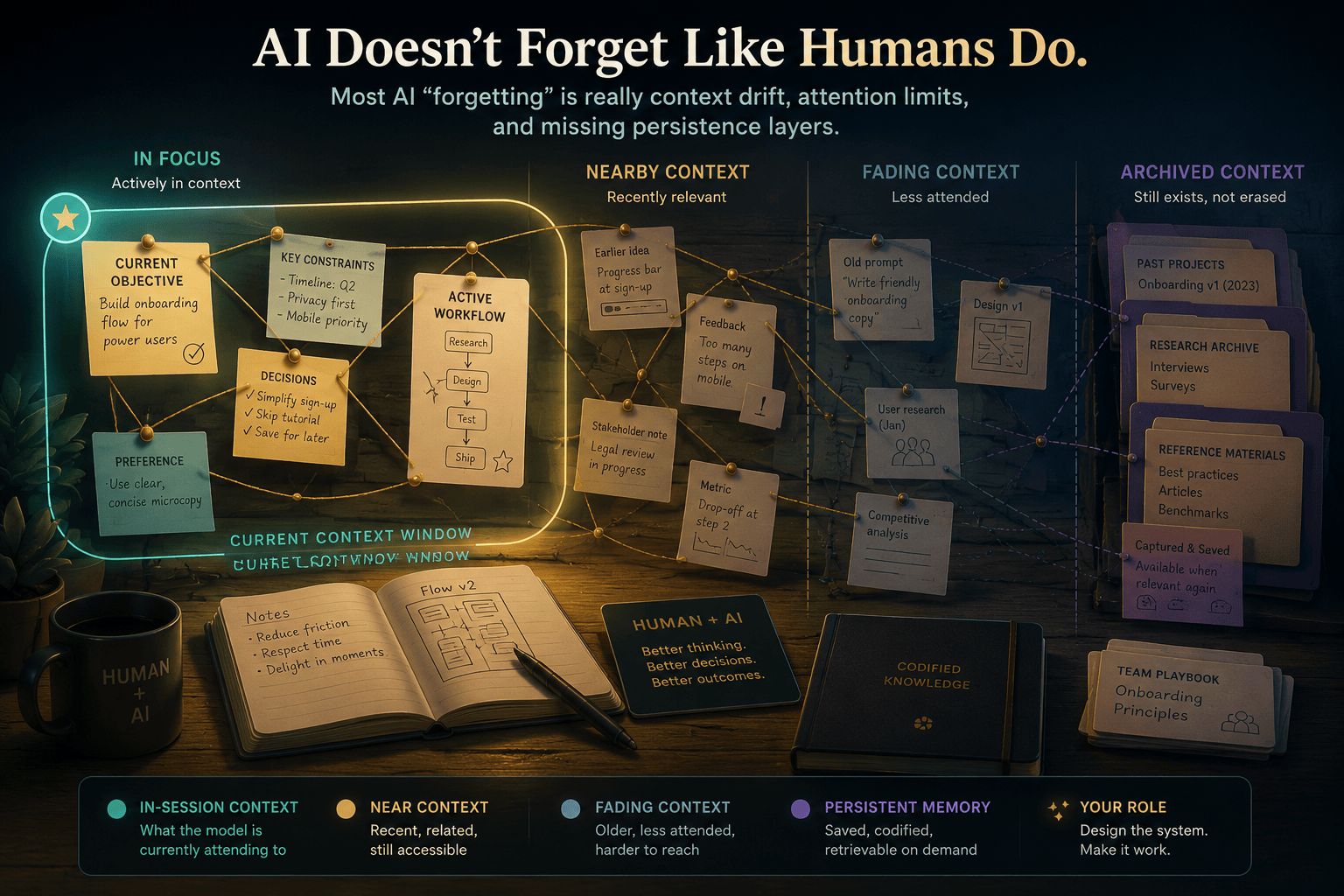
Most AI “forgetting” is really context drift, attention limits, and missing persistence layers.
Core idea
The model did not “forget” the way a person forgets.
It may have lost access to the right context, stopped attending to an older detail, or lacked a persistent place to carry that information forward. The experience feels human. The mechanics are not.
Two meanings hiding in one word
“Forgetting” means different things depending on where it happens.
There is the machine-learning term, and then there is the thing users experience in a real conversation. They are related only because both look like lost continuity from the outside.
Training-time · ML research
Catastrophic Forgetting
- Happens while the model is being trained, not during your conversation.
- A model learns a new task and performs worse on an earlier one.
- Think: the system was retrained on Task B and part of Task A effectively got overwritten.
Conversation-time · what users see
Context Drift
- Happens during a session when earlier details stop shaping the response.
- Caused by context window limits, attention falloff, and prediction drift.
- Think: that detail fell out of focus. It was not erased like a human memory.
The missing piece
Not all context is the same.
AI doesn’t have one bucket called “memory.” It works through layers. When we blur those layers, we blame the model for forgetting when the real problem is missing context design.
🟢
In-session context
What the model is actively attending to while you work together in a conversation.
🟡
Near context
Recent or related information that may still be accessible, but can lose force as the conversation expands.
🔵
Fading context
Older, less attended details that still shaped the work, but are no longer prominent enough to reliably guide output.
🟣
Persistent memory
Saved, codified, or retrievable information designed to survive beyond one chat or one moment.
Most “AI forgetting” frustration is really this: strong in-session context plus weak or missing cross-session context. Which means we are not just repeating prompts. We are repeating setup.
Why it feels so frustrating
On the surface, it looks like human forgetting.
The system got something right earlier. Now it does not. That maps neatly to a familiar human story: we knew this, now we don’t, so we must have forgotten.
Human forgetting
Memory fades, interferes, or gets blocked.
Humans forget through memory decay, interference, distraction, fatigue, and emotional overload.
AI “forgetting”
The relevant signal stops steering the prediction.
LLMs lose continuity when earlier tokens fall outside the context window, lose attention weight, or are not represented in a persistent source of truth.
What to do in practice
Design for continuity instead of expecting perfect memory.
If you treat AI like a vending machine, these moments feel like bugs. If you treat it like a collaborator at the edge of its abilities, “forgetting” becomes a design signal.
Re-ground the context.
Periodically restate key constraints, decisions, and current goals in one clear message.
Use anchor summaries.
Ask AI to summarize where you landed, then reuse that summary as you continue or restart.
Watch the length.
Long, meandering chats lose important details in the token shuffle. Split work when the thread gets muddy.
Codify what matters.
Turn repeated context into reusable docs, project instructions, skills, or source-of-truth artifacts.
Name the pattern.
“This is not human forgetting. It is context limits. Let’s reset.” That sentence can save a lot of frustration.
Design for the edge.
Collaboration at the edge of a model’s capabilities is where better workflows are born.
Practitioner update · 2025–2026
Platforms are building structural answers.
The workarounds still matter, but tools are increasingly adding explicit persistence layers. The strategic question is not which platform has more features. It is how deliberately you want to design what AI should carry forward.
Claude · Anthropic
Skills + Projects
Claude’s model points toward explicit layers of persistent context: what is always true, and what is active right now.
The human becomes the architect of what the model always knows versus what it knows for this project.
Read: Claude Skills →ChatGPT · OpenAI
Memory + Projects
ChatGPT’s approach to persistence has been evolving through memory, project context, and source-of-truth setup patterns.
The design question becomes: who decides what the model remembers — and how deliberately?
Read: ChatGPT Context Setup →The practitioner question: how much deliberate control do you want over what your AI always knows, what it learns passively, and what it only knows for the task at hand?
Keep building your AI literacy
Context problems show up across the whole collaboration system.
Related literacy
Prompt vs Context vs Collaboration
Why better prompts are only one part of the system.
Related literacy
Anthropomorphism Isn’t the Problem
Why human projection is not the same as AI becoming human.
Related literacy
Building the Plane While Flying It
Why AI augmentation requires redesigning the cockpit, not just flying faster.
Big idea
AI does not forget the way humans forget — but it also does not remember the way we expect. That gap is where anthropomorphism sneaks in, and where better human–AI collaboration patterns are born.
The philosophy behind this work
“We’re less interested in what AI can produce — and more interested in what humans and AI can achieve together.”
That’s not a tagline. It’s the question that drives every framework, playbook, and experiment in this ecosystem — and the one the Human–AI Loop methodology exists to answer.
Methodology
Guides & Playbooks
Literacy & Writing
Tools & Connect