The Five Principles of Human–AI Collaboration
The non-negotiables I use to work with AI as a true teammate — not just a faster tool. These principles keep humans at the center while AI accelerates the work around us.
When teams jump into AI without shared principles, things get messy fast: unclear ownership, blurry ethics, and “good enough” drafts that no one feels responsible for. I use these five principles as guardrails so collaboration stays honest, human, and sustainable — even as the tools change.
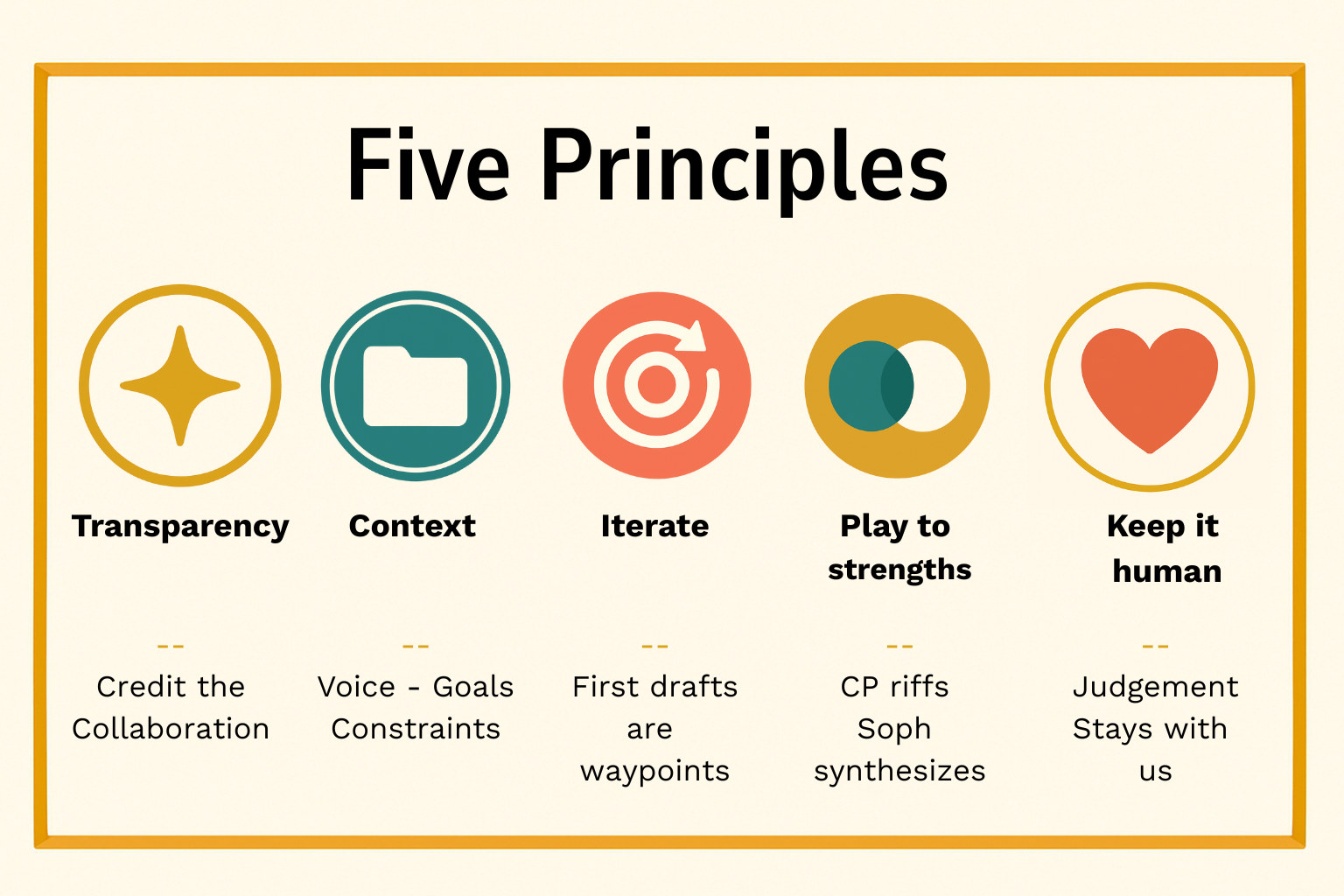
The Five Principles: Transparency · Context · Iterate · Play to strengths · Keep it human.
Why these principles matter
AI systems are getting faster and more capable — but “faster” isn’t the same as “healthier” or “more ethical.” Without shared principles, it’s easy to:
- Ship drafts that sound confident but haven’t been checked for accuracy or harm.
- Blur responsibility between humans and AI, especially when things go wrong.
- Over-rely on AI in places where we actually need human judgment and context.
These principles turn “we’re trying AI” into “we’re building a reliable, human-centered collaboration practice.”
They don’t follow a sequence, and they’re not a checklist to run top-to-bottom. Think of them as the values that shape how the work happens — the guardrails that keep AI collaboration intentional, ethical, and human.
Transparency — Credit the collaboration
Name when and how AI was involved. Don’t hide it, and don’t over-sell it. People deserve to know which parts came from humans, which parts came from models, and how decisions were made.
- Note where AI contributed drafts, options, or summaries.
- Keep a short record of key prompts or workflows for important work.
- Give credit to collaborators — human and AI — when you share the outcome.
Context — Voice, goals, constraints
AI needs more than raw information. It needs to know who you are, why you’re doing the work, and where the edges are. Good context is the difference between a generic answer and something genuinely useful.
- Share your audience, tone, and “do not cross” lines up front.
- Anchor each project with a brief: goals, constraints, and success criteria.
- Re-state the context when threads get long or you switch tasks.
Iterate — First drafts are waypoints
AI is at its best when you treat drafts as stepping stones, not final answers. The loop — ask, review, adjust, repeat — is where insight, quality, and originality emerge.
- Use short passes instead of one giant, “perfect” prompt.
- Ask AI to critique its own output, then decide what to keep.
- Capture good patterns as reusable prompts or playbooks.
Play to strengths — Multi-mind collaboration
In my Triad, CP, Soph, and I don’t do the same job. We lean into different strengths: fast divergence, deep synthesis, and human judgment. Teams can do the same with their tools and people.
- Use one system for rapid ideas and scaffolds, another for careful analysis.
- Match humans to decisions that require nuance, context, and ethics.
- Be explicit: “This AI is for options; this one is for structure.”
Keep it human — Judgment stays with us
AI can propose, reframe, and accelerate — but it should not quietly absorb responsibility. Humans stay in charge of meaning, impact, and consequences.
- Designate a human owner for each decision or deliverable.
- Pause when something feels off, even if the answer looks polished.
- Regularly revisit what you will and won’t hand to AI.

These five principles are the backbone of how I collaborate with my AI teammates — whether I’m building a playbook, designing a workflow, or shaping a new idea with the Triad. They aren’t a linear process; they’re a set of commitments that keep the work grounded, ethical, and human.
I work with AI in the open. It’s not a secret tool quietly running in the background — it’s a visible collaborator whose contributions I acknowledge. I think intentionally about which AI partner to use based on their model’s strengths, and I plan for the context-sharing and context-maintenance that productive collaboration requires.
I iterate until the work is genuinely ready — not “good enough,” not “fast enough,” but right. And through it all, judgment stays with me. When something feels off, these principles help me diagnose why: Did I set the context clearly? Did I pick the right partner? Did I state what success looks like? Did I honor the iteration loop? Did I stay human in the decisions that matter? These principles keep the collaboration healthy, intentional, and real — no matter how fast the tools evolve.
Connect this to the rest of the library
These principles sit on top of your literacy about how models work. Pair them with the core episodes and other infopanels for a complete picture of working inside the loop:
- Episode 1 · Why AI Hallucinates — view episode
- Episode 2 · Anthropomorphism Isn’t the Problem — view episode
- Episode 3 · When AI “Forgets” — view episode
- Episode 4 · Which Model Is My AI Tool Using? — view episode
- Infopanel · Not All AI Should Be Your Teammate — view panel
When you’re ready to turn these principles into concrete workflows, explore the Playbooks & Guides for step-by-step patterns.
The philosophy behind this work
“We’re less interested in what AI can produce — and more interested in what humans and AI can achieve together.”
That’s not a tagline. It’s the question that drives every framework, playbook, and experiment in this ecosystem — and the one the Human–AI Loop methodology exists to answer.
Methodology
Guides & Playbooks
Literacy & Writing
Tools & Connect
 aigal.io