Episode 1 of the Human–AI Literacy Library

Human–AI Literacy Library · Episode 1
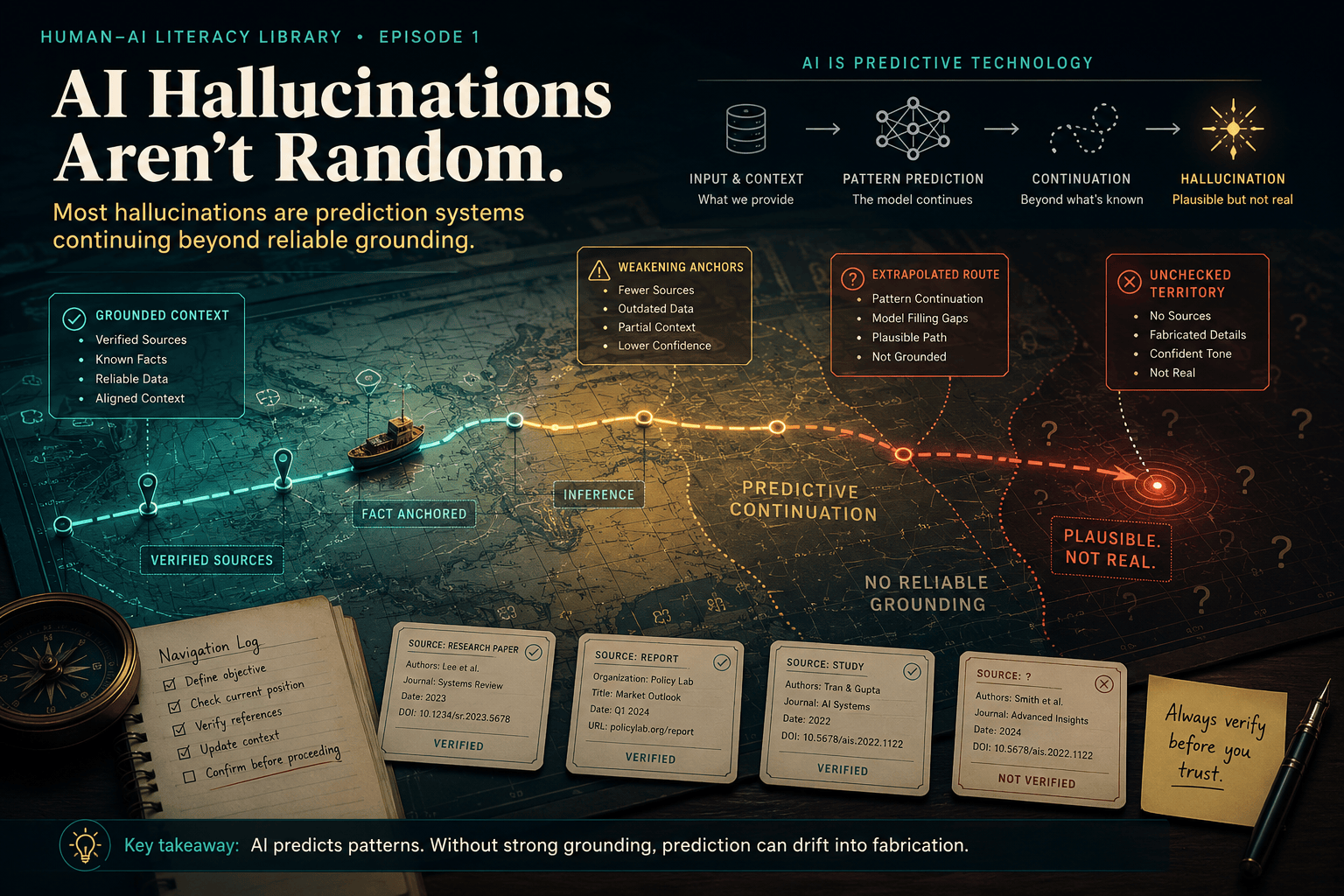
AI Hallucinations Aren’t Random.
Most hallucinations are prediction systems continuing beyond reliable grounding.
The model did not “lie” the way a person lies.
It predicted the next plausible thing.
That distinction matters. A hallucination is usually not malice, intention, or a database error. It is what can happen when a predictive system keeps going after the grounding gets weak.
What hallucinations are — and are not
The problem is plausibility without grounding.
Hallucinations are confusing because they often sound polished, confident, and useful. The language feels complete even when the evidence underneath is not.
What they are
Confident outputs that are not reliably grounded.
- Plausible but wrong, incomplete, or fabricated details.
- The model filling gaps when it lacks enough context.
- Pattern continuation, not fact retrieval.
- Often triggered by vague prompts, missing context, stale information, or weak sources.
What they are not
Not proof that AI is trying to deceive you.
- Not intentional lying. The model has no motive to protect.
- Not a simple database lookup bug.
- Not human forgetting.
- Not something you can fully “turn off” with one setting. It is a structural risk of prediction-based systems.
Where hallucinations come from
AI predicts patterns. Prediction can drift.
The issue is not that the system suddenly becomes chaotic. It often remains coherent while gradually moving beyond reliable reference points.
Prediction, not retrieval
LLMs generate likely continuations. When patterns are weak, conflicting, or out of date, the continuation can sound fluent without being true.
Weak grounding
Without reliable files, tools, retrieval, or sources, the model has less to anchor on — especially for recent, niche, or organization-specific work.
Ambiguity & context limits
Vague prompts, missing constraints, and long meandering threads force the system to infer more than it should.
How to spot it in the wild
Watch for fluency without a trail.
No sources, no trail
The model cannot show where a specific claim came from, even when you ask.
Confidence on fuzzy topics
The answer sounds too certain about something complex, niche, ambiguous, or fast-moving.
Details that smell off
Dates are slightly wrong. Names are misspelled. Quotes feel close, but not quite real.
Made-up specifics
Tools, URLs, APIs, citations, or org structures that do not exist when you verify them.
Design around hallucinations
Don’t just warn people. Build better loops.
The goal is not to pretend hallucinations do not exist. The goal is to design prompts, workflows, review steps, and team norms that catch them early.
For individuals
Verify first. Trust later.
- Verify facts, numbers, names, and sources.
- Use files or retrieval when you need grounded answers.
- Keep prompts specific and scoped.
- Treat outputs as drafts to react to, not final truth.
For teams & systems
Decide where AI drafts vs. decides.
- Double-check critical steps with humans or trusted tools.
- Use RAG and source-of-truth documents for grounded workflows.
- Make uncertainty labeling part of the workflow.
- Include hallucination review in retros, post-mortems, and design reviews.
Big idea: AI predicts patterns. Without strong grounding, prediction can drift into fabrication. Better human–AI collaboration means designing the verification loop, not pretending the risk disappears.
Keep building the mental model
Related AI Literacy pieces
Episode 2
Anthropomorphism Isn’t the Problem →
Why humans assign intention and personality to systems.
Memory & context
AI Doesn’t Forget Like Humans Do →
Why most “forgetting” is context drift, attention limits, or missing persistence.
Practice layer
Prompt vs Context vs Collaboration →
Why better prompts help — but better collaboration systems matter more.
The philosophy behind this work
“We’re less interested in what AI can produce — and more interested in what humans and AI can achieve together.”
That’s not a tagline. It’s the question that drives every framework, playbook, and experiment in this ecosystem — and the one the Human–AI Loop methodology exists to answer.
Methodology
Guides & Playbooks
Literacy & Writing
Tools & Connect