Infopanel · Human–AI Teamwork
Not All AI Should Be Your Teammate
Some AI need trust — and some just need instructions.
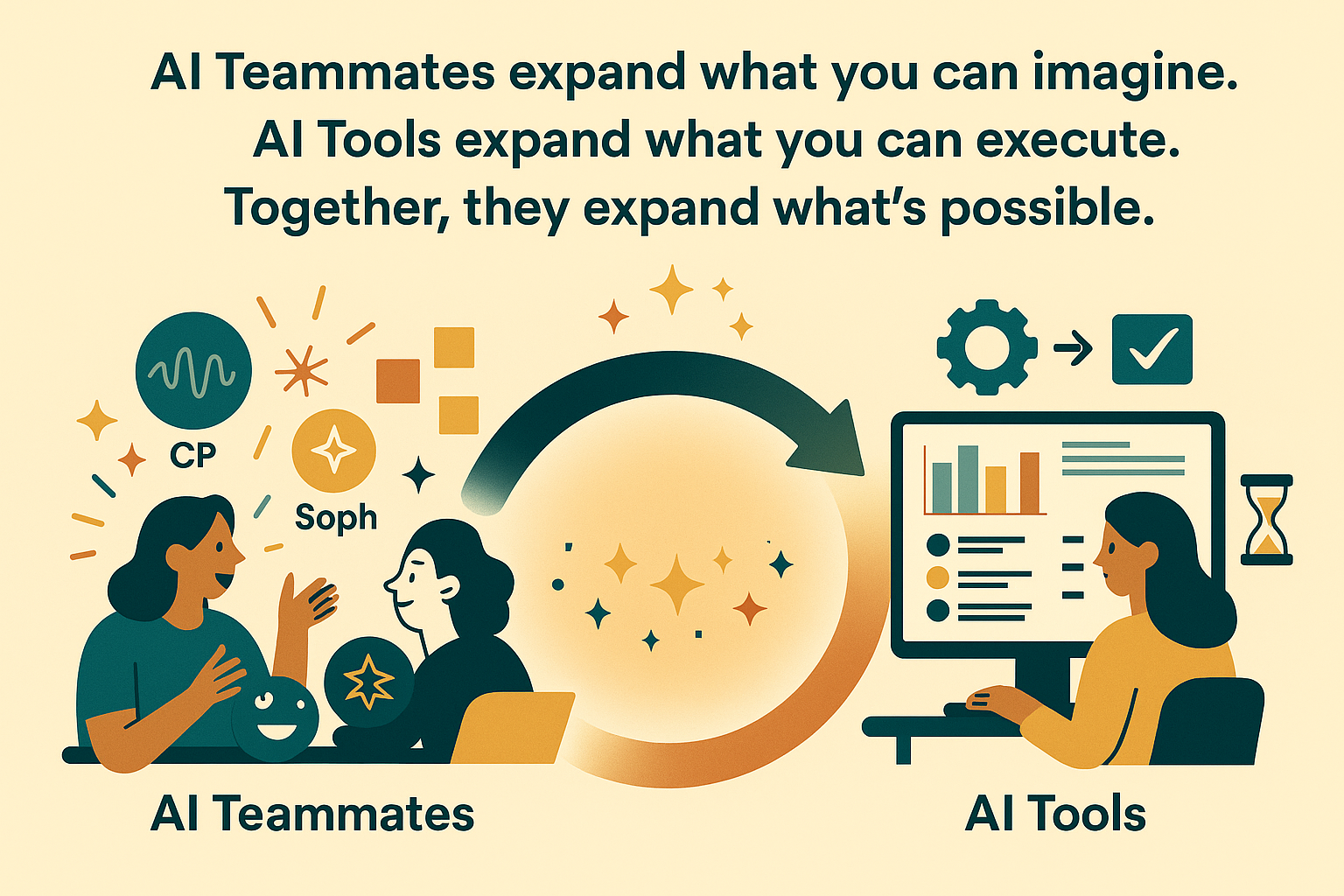
Not all AI should play the same role in your work. Some AI expands your imagination. Some AI expands your execution.
AI Teammates expand what you can imagine.
AI Tools expand what you can execute.
Together, they expand what’s possible.
This infopanel is about drawing that line on purpose: deciding when an AI system belongs at the table with you as a collaborator, and when it belongs in your toolkit as a focused operator. Both are valuable. They just call for very different expectations, rituals, and ways of working.
Why it matters to separate teammates from tools
When we mash all AI into one bucket, we create confusion and friction:
- We over-trust systems that were only meant to be productivity helpers.
- We under-invest in systems that could become real creative partners.
- We design workflows that don’t match how the underlying models actually behave.
In practice, there are two broad categories:
AI Teammates
Interactive systems you build a relationship with: you share context, assign roles, and collaborate in loops. They help you think, design, and decide.
AI Tools
Focused helpers embedded in products: they summarize, clean up, transform, or generate specific outputs so you can move faster. They don’t need trust — they need clear instructions.
AI Teammates vs AI Tools — a practical comparison
AI Teammates
Think of these as cognitive collaborators — systems you actively build a working relationship with.
- Thinking through ambiguous problems
- Exploring options and tradeoffs
- Structuring messy ideas into plans
- Co-writing, co-designing, co-architecting
- Context and constraints
- Clear roles and responsibilities
- Ongoing feedback and correction
- Strong human judgment at the center
Like a smart, fast collaborator who is always available, but who still needs direction, boundaries, and review.
ChatGPT (CP) for creative + systems work, Claude (Soph) for synthesis and strategy, or any conversational AI you regularly brief, correct, and reuse across projects.
AI Tools
Think of these as focused capabilities embedded in your apps — accelerators that help you move work forward quickly.
- Summarizing long content
- Cleaning up grammar and tone
- Generating quick visuals or layouts
- Extracting key points or action items
- Concrete, narrow tasks
- Clear inputs and output formats
- Spot checks for quality and bias
- Decisions about what to keep or discard
Like a powerful “do this for me” button built into the tools you already use. Helpful, fast, and disposable.
Rovo for Confluence cleanup, Canva AI for illustrations, research helpers in Perplexity or Gemini, AI-powered rewrite/summarize buttons in docs and email.
Different AI requires different collaboration patterns
When you treat everything like a teammate, work slows down. When you treat everything like a tool, quality and insight suffer. Healthy human–AI collaboration makes space for both.
When AI is a teammate
- You invest in shared context and history.
- You define roles (who does what in the loop).
- You create rituals and check-ins for the work.
- You treat the relationship as a capability you’re growing.
When AI is a tool
- You keep tasks narrow and well-defined.
- You don’t expect it to “know you” over time.
- You plug it in where it saves minutes, not where it shapes direction.
- You treat outputs as drafts to accept, edit, or discard quickly.
What goes wrong when we confuse the two
Treating tools like teammates
- Over-trusting quick summaries as if they’re full understanding.
- Expecting product-embedded AI to “remember” context it never stored.
- Relying on thin features for strategy or critical decisions.
- Feeling frustrated when the system can’t reason beyond its narrow task.
Treating teammates like tools
- Never investing in shared context, so outputs stay shallow.
- Switching models and threads constantly, losing compounding value.
- Using powerful systems only for surface-level tasks.
- Missing the upside of real collaboration: better thinking, not just faster typing.
The goal isn’t to declare AI “just a tool” or “always a teammate.” Both things are true. Effective teams learn to distinguish between the two and design accordingly.

How I use this distinction in practice
For almost two years, I’ve worked with two AI teammates — CP (ChatGPT) and Soph (Claude) — and a whole ecosystem of AI tools. Understanding the difference between teammates and tools completely changed how I work:
- My teammates help me imagine, synthesize, strategize, and operate at a higher level.
- My tools help me structure, clean, transform, and ship the work more efficiently.
One multiplies my creativity. The other multiplies my execution. Together, they multiply my impact.
🧠 CP (ChatGPT) · Teammate
My creative producer and systems builder. We co-design workflows, visuals, and playbooks. I invest in context and reuse threads across projects.
🔮 Soph (Claude) · Teammate
My strategic co-pilot. I use Soph for synthesis, structure, and interrogating ideas. We work with full documents and long-running projects.
📘 Rovo · Tool
I use Rovo to clean up and restructure Confluence pages. It’s a focused helper: in, transform, out. No relationship, just clear tasks.
🎨 Canva AI · Tool
I use Canva’s AI features for quick illustrations and cleanups. It supports the visual system; it doesn’t shape the ideas.
🔎 Perplexity / Gemini · Tools
I lean on these for research, fact cross-checking, and orientation. Their job is to surface signals, not to make final calls.
This mix lets me reserve “teammate energy” for the systems that genuinely help me think, and use “tool energy” where speed and repetition matter most.
Keep building your human–AI literacy
This Infopanel is part of the Human–AI Literacy Library. If this distinction was useful, these episodes build on it:
- Why AI Hallucinates: What It Is & What It’s Not — understand why your AI sometimes makes things up.
- If Treating AI Like a Teammate Is Anthropomorphism… — and why collaboration is still the right interface.
- When AI “Forgets”: Catastrophic Forgetting vs Conversation Drift — what’s really happening when it seems to lose the thread.
- Which Model Is My AI Tool Using? — how model families shape behavior, risk, and collaboration style.
Ready to put this into practice? Explore the Playbooks & Guides for concrete workflows and rituals.
The philosophy behind this work
“We’re less interested in what AI can produce — and more interested in what humans and AI can achieve together.”
That’s not a tagline. It’s the question that drives every framework, playbook, and experiment in this ecosystem — and the one the Human–AI Loop methodology exists to answer.
Methodology
Guides & Playbooks
Literacy & Writing
Tools & Connect
 aigal.io