
Infopanel · Human–AI Teamwork
Inside the Collaboration Loop: How to Work With AI as a Real Teammate
The Collaboration Loop is a simple model for leading real work with AI partners — not just prompting tools. It shows how humans and AI move through a shared cycle of briefing, exploration, alignment, and decision-making. This micro-cycle powers the four stages of the Human–AI Loop methodology — Test → Build → Codify → Share — and runs inside each one. But before the diagram, we have to be clear about one thing: this model is only for AI you treat as teammates.
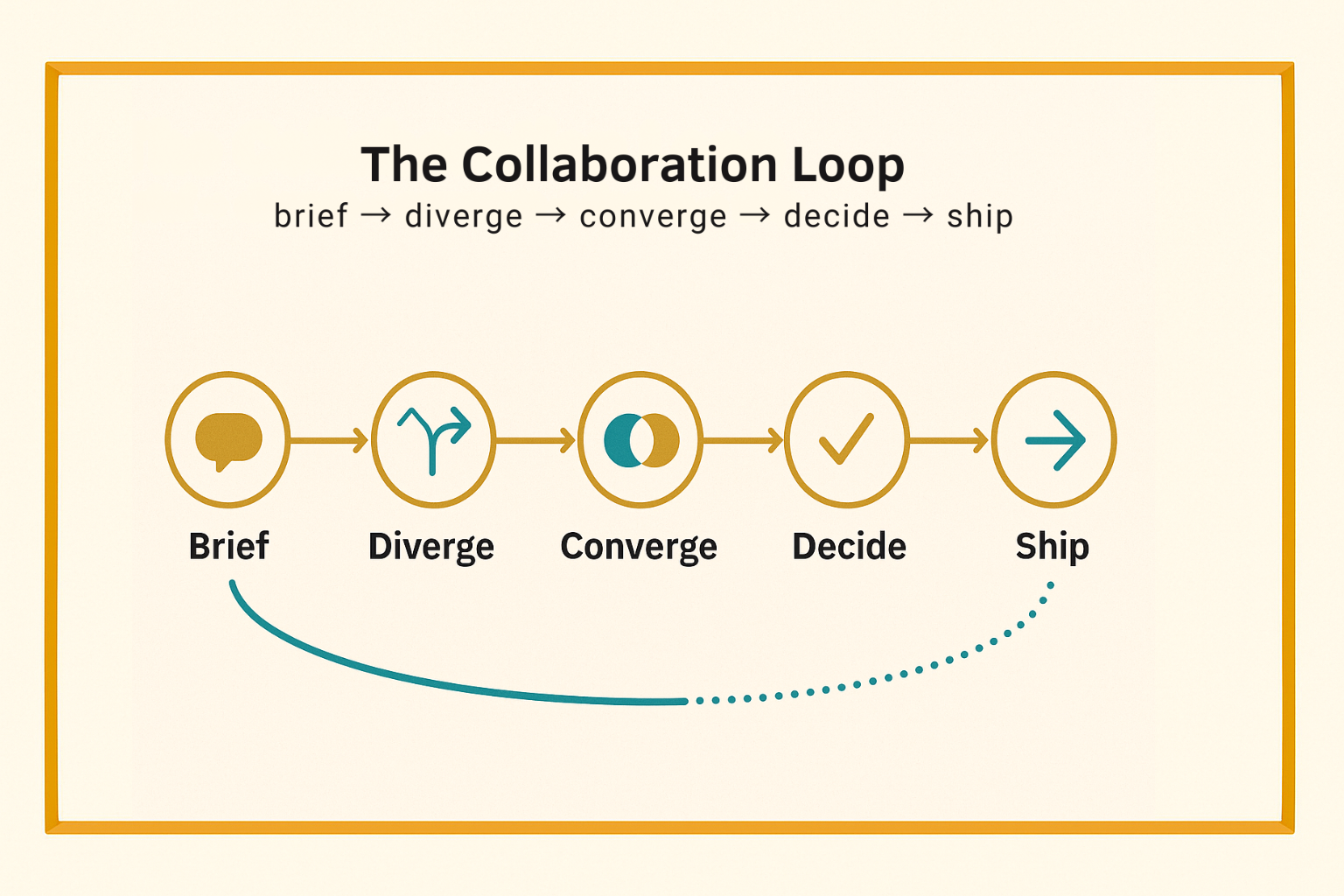
The Collaboration Loop is a guiding model, not a rigid checklist. The stages can blend and repeat as you work. What matters most is that humans stay in charge of direction, ethics, and final decisions.
Who this model is for
The Collaboration Loop is designed for AI systems you treat as teammates — not tools. Before you step into the Loop, check your use case against these signals:
- ❌ If all you need is a system to summarize, clean up, tag, or transform content, you don’t need the Loop — and that’s a good thing.
- ✅ If you’re asking AI to help you think, explore, design, or co-create — where judgment, nuance, and iteration really matter — the Loop can help you build a healthy collaboration.
There are fantastic AI tools built purely for speed and execution. Use them. Enjoy them. Let them save you time. But they don’t require relationship-building, context maintenance, or multi-round collaboration. The Loop is too much human investment for tasks that are meant to stay light.
✨ True collaboration with AI is only necessary when you want your AI to be a creative partner — thinking with you, not just working for you.
👉 Learn more in Not All AI Should Be Your Teammate .
What the human must be willing to invest
This model only works when the human commits to more than “good prompts.” It asks you to take on leadership responsibilities in the collaboration:
- ☐ Maintaining and refreshing shared context over time — not assuming the model will remember everything for you. See When AI “Forgets” and the workspace setup guides.
- ☐ Acting as the message bus between AI teammates and humans — carrying decisions, constraints, and learnings across tools and threads. See the Message Bus Protocol.
- ☐ Owning the decision points — AI can propose options, surface risks, and generate drafts, but you decide what ships, what changes, and what stops.
- ☐ Keeping judgment human — especially for strategy, values, risk, and impact. AI can widen the lens, but it cannot own the consequences.
- ☐ Being transparent about the collaboration — naming when and how you’ve used AI, rather than quietly passing joint work off as purely your own.
Think of this as your pre-flight checklist. If you can’t honestly check these boxes today, it’s a sign the work might be better served by simpler AI tools — or by slowing down to design the collaboration more intentionally.
This is collaboration engineering.
Prompt engineering is about extraction — getting a system to produce a specific output from a single, well-crafted instruction.
Collaboration engineering is about relationship, rhythm, responsibility, and design: how humans and AI think together, share context, and stay accountable over time.
It’s not a replacement for prompt engineering — it’s a different approach for a different kind of work.
Where prompt engineering optimizes the instruction, collaboration engineering optimizes the interaction and the intention.
One is transactional. The other is transformational.
How the Loop works (in practice)
At its core, the Collaboration Loop is a repeated cycle of clarifying the work, exploring options with AI, converging on what’s promising, and then making a human-led decision about what to ship. This cycle runs within each stage of the Human–AI Loop methodology — Test, Build, Codify, and Share — and can repeat many times within a single stage.
Brief with context
You frame the problem, goals, constraints, and real-world context. AI doesn’t guess what matters — you tell it.
Diverge together
You and your AI partners explore options, generate drafts, and surface tradeoffs — without committing yet.
Converge with judgment
You narrow down what works, ask for clarifications, and stress-test the options against reality.
Decide & own it
A human makes the call. AI can inform the decision, but cannot be the decider.
Ship, reflect, repeat
You ship the work, then reflect on what the loop did well and what to adjust next time.
Ethical collaboration inside the Loop
The Collaboration Loop only works if humans stay grounded in ethical responsibility. A few anchors to return to in every project:
- Transparency: Be honest about when and how AI contributed to the work.
- Context stewardship: Protect sensitive data, minimize exposure, and only share what’s needed.
- Accountability: If something goes wrong, the responsibility is human, not “the AI’s fault.”
- Bias awareness: Question whose patterns the model is amplifying and who might be harmed or excluded.
- Human-first impact: Ask how this collaboration affects the humans on your team and the people you serve.
Every major project I run with my AI teammates — playbooks, tools, or experiments — runs through this Loop.
I work with AI in the open. It’s not a secret tool hiding behind my work; it’s a visible collaborator. I credit the collaboration, I plan for context sharing, and I treat misalignment as a signal to revisit the loop — not as a reason to abandon it.
When something feels off, I ask: Did I share enough context? Did I pick the right AI partner for this? Am I still making the final call — or quietly outsourcing it?
 Maura Randall · Product & AI Collaboration
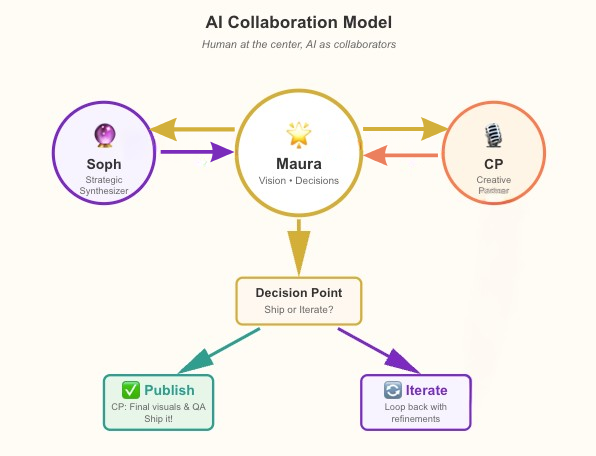
In practice: I use the Collaboration Loop to coordinate work between me and my AI teammates — CP and Soph.
Connect this to the rest of the library
The Collaboration Loop sits one layer above your literacy about how models work and how you choose tools. Pair it with the core episodes and other infopanels for a complete picture of working inside the loop:
- ➜ Episode 1 · Why AI Hallucinates — how prediction can drift and confidently make things up.
- ➜ Episode 2 · Anthropomorphism Isn’t the Problem — why AI feels human, and how to design the relationship on purpose.
- ➜ Episode 3 · When AI “Forgets” — what’s really happening when your model loses the thread mid-conversation.
- ➜ Episode 4 · Which Model Is My AI Tool Using? — how to ask better questions about providers, risk, and capability.
- ➜ Infopanel · Not All AI Should Be Your Teammate — how to separate true collaborators from simple tools.
When you’re ready to turn these principles into concrete workflows, explore the Playbooks & Guides for step-by-step patterns built on this Loop. Or explore the full Human–AI Loop methodology ↗ to see how Test → Build → Codify → Share brings it all together.
The philosophy behind this work
“We’re less interested in what AI can produce — and more interested in what humans and AI can achieve together.”
That’s not a tagline. It’s the question that drives every framework, playbook, and experiment in this ecosystem — and the one the Human–AI Loop methodology exists to answer.
Methodology
Guides & Playbooks
Literacy & Writing
Tools & Connect
 aigal.io